Kendra Pitman, “The Blood Poured Out for Me”
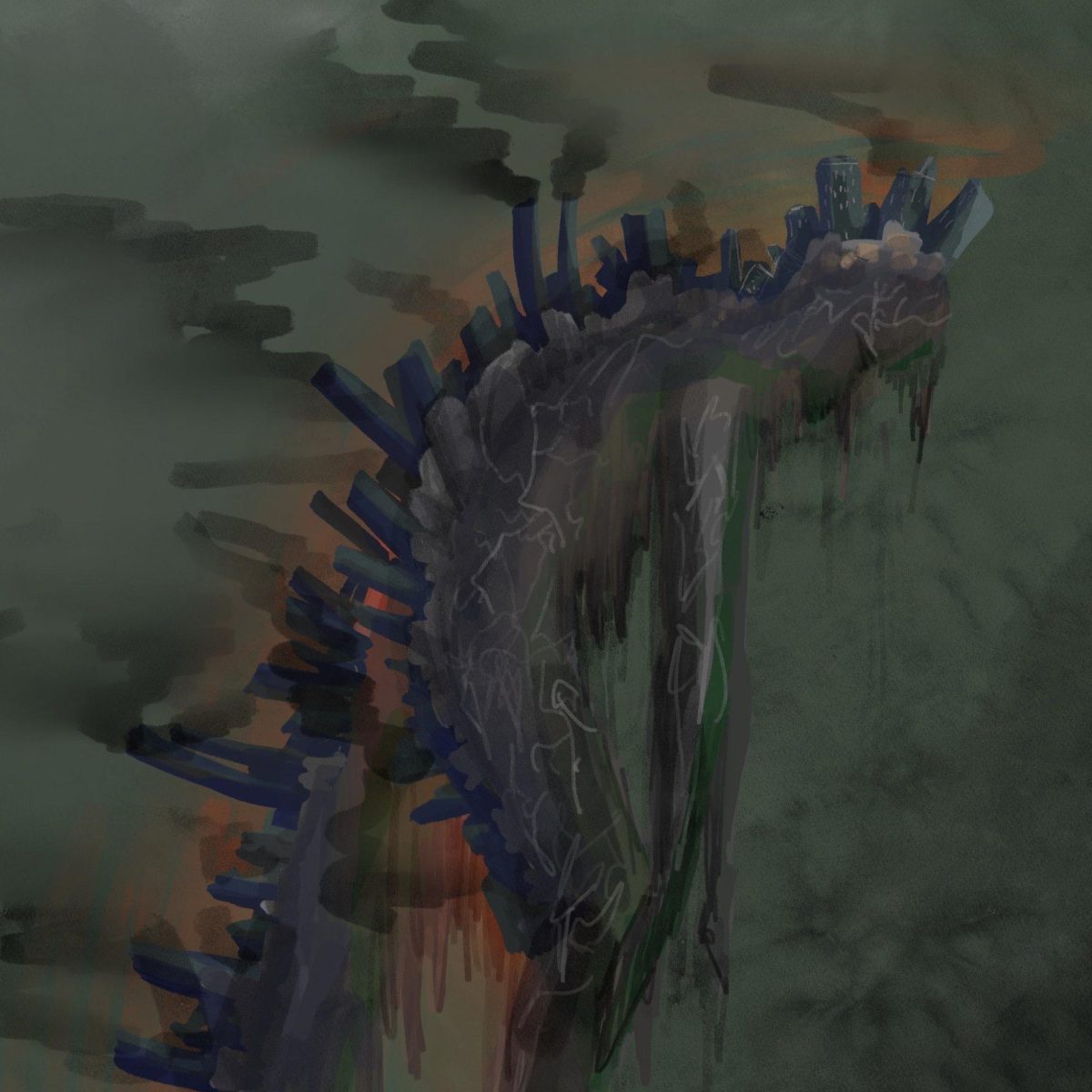
The fog has gotten worse these past few weeks. Mother says it’s cause God left a blanket over the city by accident, but I’m old enough to know how fumes work.
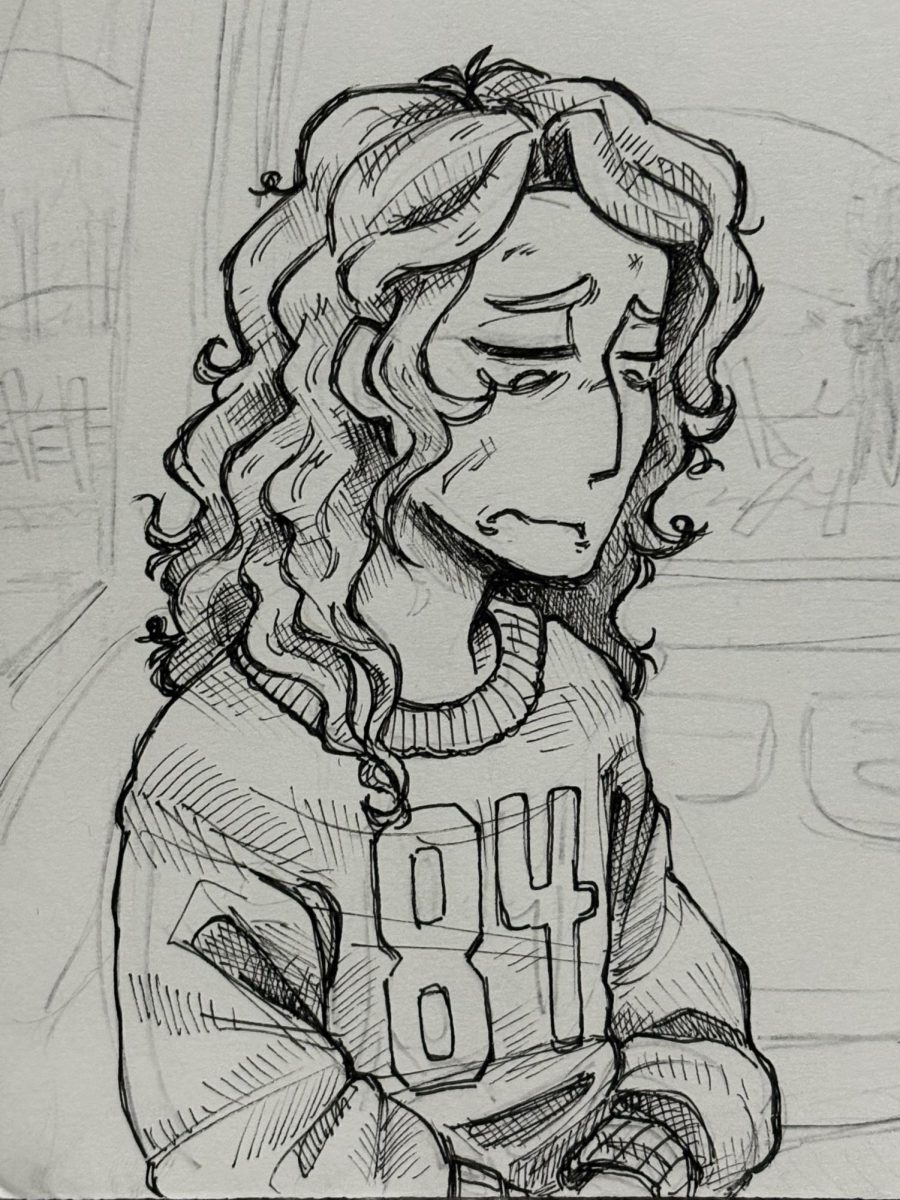
I pull up the hood of my jacket, the oversized one mother says I’ll grow into, and bite down on it so my mouth is full of cloth. It doesn’t cover my nose, and, stepping outside of our first-story studio apartment, the heavy gasses flood into my nostrils. It’s uncomfortable, but we sold our masks two days ago to pay for rent and haven’t made enough money to buy new ones yet.
The city is just the same as it was yesterday.
Cars, swimming down the streets in quick flashes. Lights so bright that they shine like little stars all around the city. Buildings, towering so high that they could be Babel. Of course, there’s the vendors, crouched over their stands and shoving food or jewelry down people’s pockets in exchange for quarters. My job is simple. I wave a trash bag up and down. It makes a loud thrashing sound as it opens, and I hold it in front of me as I look down towards the floors. Aluminum cans thrown haphazardly around, the copper in electrical wiring that’s been left exposed–I make quick work of it, and, once my bag gets heavy, I throw it over my shoulder, letting my back take the blunt of it.
“Did you know,” I hear, and turn, “there used to be stars. Real ones, not like street lamps. A whole sky of them.”
The man on Gilmore Street sets his stand down at this corner every Wednesday, Friday and Sunday. He sells tortas. There’s a leak in his canopy. When it rains, the dirty water mixes with the dough. Mother says it gives the food flavor. “Was there?” I ask him, leaning over the counter. He’s old–wrinkles scarring his face, and not getting any younger as the years go by. He nods at me, slow and burdened.
I know there was. I’ve read about it, back when we lived near the library, and imagined what it would be like to lay on a field–an open field, with flowers and grass and everything, and look up into the stars. “Yes ma’am, and there was air we could breathe without choking, too”. The man–I’m yet to learn his name, knows that I’m not going to buy anything. But I pay him, I think, with something better.
Conversation can be hard to come by, these days.
I collect the cans left nearby, he hands me some of the scraps of metal that his customers left, we thank each other, and I go another way.
I have a defined path. It helps, in part, cause it forces me to remember what streets to turn on, like muscle memory. Down past the apartment buildings, through Gilmore Street, then take a turn at the old park that’s being demolished, before making my way down to the compost. It’s predictable–easy to latch onto. Many things are these days.
It’s hard for me to see the city as any color other than a dull, deafening gray. Just by waking up, I am navigating a pool of oil, hurling my body forward, forward, forward, until I’m covered in it and slugged down in exhaustion, unburdened only in dreams.
I take a stop when I’m supposed to turn onto Hilbert Road, and allow myself to really look.
It’s rained recently. The floors are still damp, and there’s puddles collected on the sides of the roads. In the books, they would say it smells like wet grass. I don’t know. It smells all the same to me. I turn my head towards the shaggy apartment complex standing just around the corner. My aunt used to live here, before she got sick and coughed her lungs dry. Last week, there was a fire, and the bad construction turned worse. At least the rent went down, probably. I eye the scene. It looks abandoned, though I know that’s not right. A better way to describe the place would be lifeless.
Just as I think this, something moves.
I blink. It moves again, gently, slowly. My hand tightens on the bag. Is it a person?
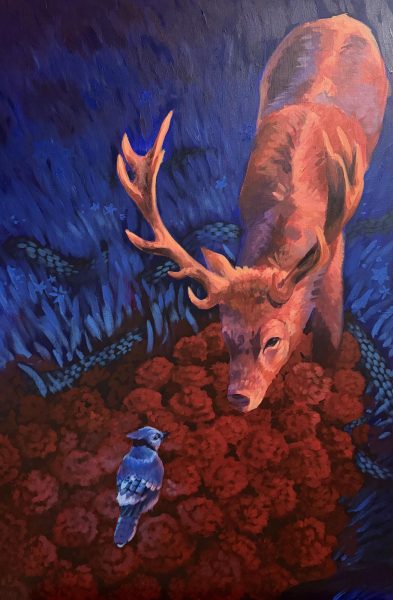
Something lifts its head up, and, from a distance, I see a bony crown appear. An animal? Despite myself, my feet inch forward. I should continue my path. I should turn onto Hilbert Road, and keep going until I get to the compost. The creature (?) moves again, and already, I am nearing it.
An animal. Definitely an animal. I bite the inside of my mouth and shove the guilt down. I can continue the path in a second. Mother won’t notice if I’m a few minutes late. This is just a quick detour.
By the time that I get closer, I’m certain I’ve seen this animal before. Not in person–never in person, the best I can usually see with my own eyes are the stray cats and crows, sometimes a vulture. This animal is different. Like a dog, only skinnier, and its brown hair cut short. I set my bag down when I crouch near it.
It’s laying on the concrete floor of the walkway towards the apartments. Its long, thin legs are jumbled about itself, and its crown–like two twin thorns protruding from its head, is resting as well. When I reach my hand forward, it flinches, tries to scramble to its feet but is left pathetically kicking. “Hey,” I whisper to it.
Then, I notice the gash on its belly. Blood, squirming from out its body. I frown. “Hey,” I repeat, smoothing down its hair until it stops fighting me. I try to get a better look at its wound. I’m not quite sure what it’s from, but I know that it looks ugly, and mother taught me how to bandage ugly cuts back when I started to work.
It’s small, maybe a baby, still small enough for me to tuck it under one of my arms while the other holds the bag.
I consider my options. My fingers, grasping at the bag, are destined to slip if I keep up the weight. I try, at first, to continue my path, to make it all the way to the compost, but I don’t last long. The creature is crying in my arms, and the bag is slowing me down, and I can feel the length of my arms burn. I stop, leaving the bag on the road. My body feels lighter, like this, and I go straight home. Mother will be upset. The animal will survive.
By the time I reach home, the animal has quieted down.
“What’s this?” mother asks me, when I walk in.
“An animal,” I say. “It’s hurt.”
Mother looks at the creature, twitching under my care, and narrows her eyes. “It’s an animal. Come here, give me the money from the compost and we can throw that thing out in a minute.”
I pause. Mother raises an eyebrow. “Honey, give me the money.”
“I didn’t make it to the compost,” I say, trying my best to keep my head up as mothers face contorts into something like anger, something like disgust. “I needed to bring it home,” I say, hugging the animal closer.
Mother approaches me. I take a step back when her hand hovers towards the animal. “What is wrong with you? How am I supposed to pay for food now?”
“You have a job, ma. Ma, please,” I try, urgency heavy in my voice. “It’s hurt.” She says nothing for a moment. “Where are the bandages?” I ask.
Mother sighs, rubbing at the side of her head. “You’re not going to waste my bandages on that thing. It’s just an animal.”
“Ma–”
“Do you even know what kind of animal it is?” It’s meant to be a question, but it comes like an accusation. I freeze. I look down at the animal, now sleeping in my arms, and then back at mother. I bite the inside of my mouth. She sighs. “Honey, come on. It’s just an animal.”
“You’re just an animal,” I say, trying my best to keep my breathing even. “I’m just an animal. Can’t we look after each other?”
Mother comes up next to me and presses a kiss on my forehead. She smooths my hair down, and I calm, just a little. “You know I look after you. I’d give anything in the world for you.”
The apartment is loud, in its own way. Even when neither of us speak, the wiring buzzes. Eventually, I say: “I know. I know. I’m sorry.” I cradle the animal closer to my chest. “I just really want it to live.”
“It’s a cruel world. Not everything is meant to survive.”
“But it was, ma,” I cry. “It was meant to run around in the grass. There’s meant to be grass. There’s meant to be a whole world of trees and rivers and stars, ma. There used to be a whole sky of stars.”
This takes mother aback. She crosses her arms, and sighs, something heavy. She looks tired, her eyes burdened, like she knows more than she ever wanted to know. “That’s not a life we get to have. And if we–if you want to survive, you need to learn to be loveless, sometimes.”
The word loveless nearly echoes. I can tell she regrets the word, just enough to duck her eyes away from me. I can tell she meant it, because she does not take it back. I don’t look at her either.
“Please ma, just this once.”
Mother nods, eventually, resolution on her face. “Okay. I’ll take it somewhere tomorrow. A doctor, just for animals. A vet. Okay?”
“Thank you, ma.”
She takes one last look at the animal in my arms before disappearing into the kitchen to prepare potatoes. As she leaves, I hear her whisper: “You have too big a heart. The world is going to eat you.”
Tomorrow, the animal will be gone. Mother will tell me that she has taken it to the vet. I will go pick up metal cans, and the elderly man will not be there, and I will follow the path until I reach the compost. When I come home for lunch, we will have meat for the first time in years. It will taste juicy, and like the earth, and I will ask her what it is. “Deer,” she will tell me, and I will nod, and I will not know what that is.